Joint vision-tactile prediction for robot policy evaluation and learning.
Real robot recordings
Tactile Textures
Distinct tactile patterns from grasping different objects.
Wrist View
Left hand
GTLeft grasp
Marker Disp.
90th percentile XYZ displacement · native units
Shaft
Contact selection
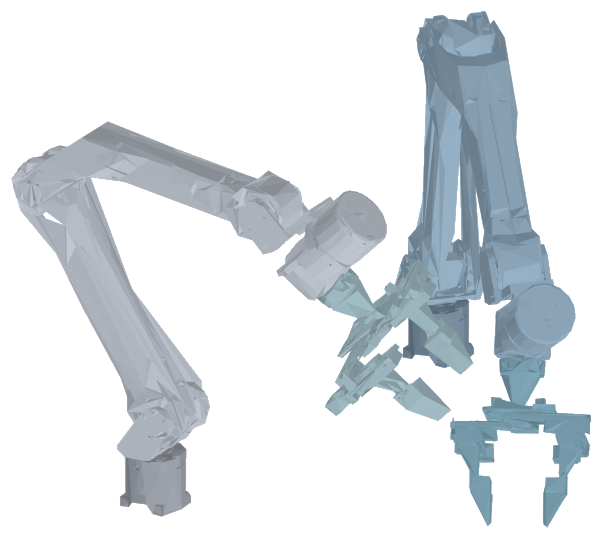
Representative object · schematic robot pose
Grasp, handover and right-hand reorientation.
Tactile Response
Two paired surfaces
Surface 0Surface 1
Sensor-plane marker arrows · display scale ×5
Loading recording…
PhysCanvas
Overview
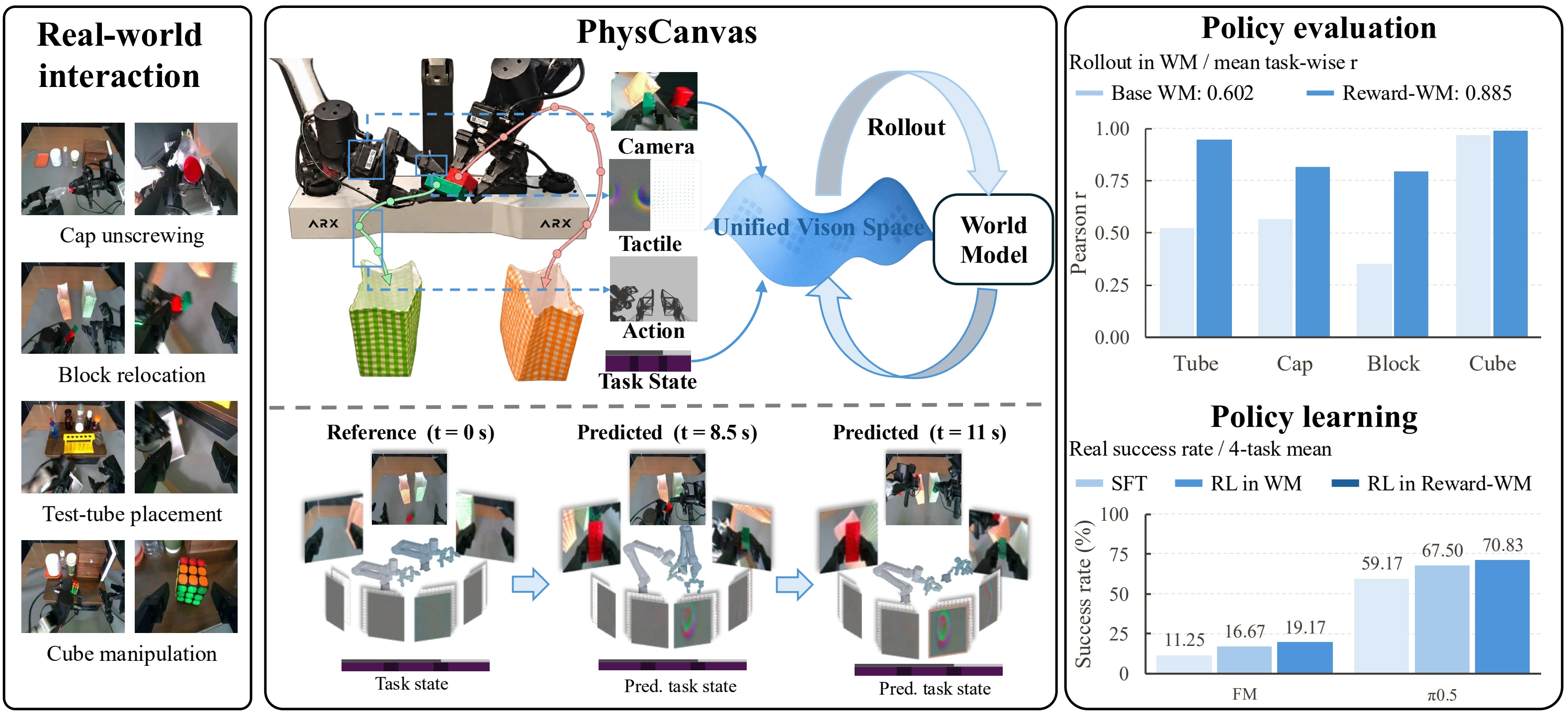
PhysCanvas maps multi-view RGB observations, tactile images, marker displacement, task state, and actions into a unified visual space. Conditioned on projected robot motion and reference observations, the model jointly predicts visual and tactile futures. Reward-based supervision supports consistent interactions, enabling robot policy evaluation and learning through imagined rollouts.
Framework
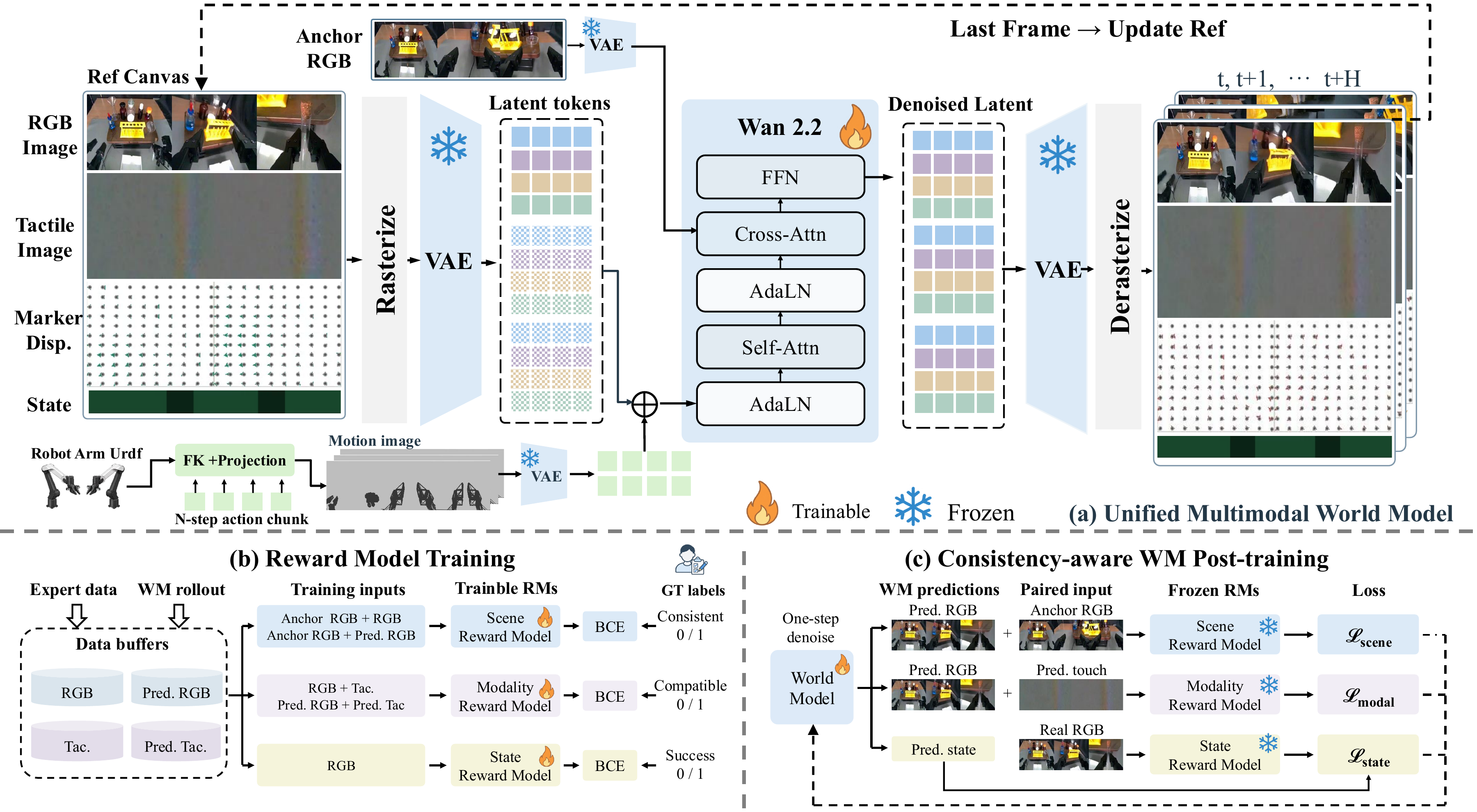
Unified multimodal generation. PhysCanvas combines multi-view RGB, tactile images, marker displacement, and task state in a unified canvas. A shared video VAE and Wan 2.2 predict future observations, conditioned on projected robot motion, an initial RGB anchor, and updated reference observations.
Consistency-aware post-training. Scene, Modality, and State Reward Models are trained using expert data and world-model rollouts. These reward models are then frozen to guide post-training toward scene consistency, visual-tactile compatibility, and agreement between predicted task state and task outcomes.
Feature Projection
Modality structure before and within the world model.
After VAE
Transformer block 1
Transformer block 15
Transformer block 30
Multi-view RGB, tactile images, marker displacement, and task state are projected into the same visual space; the panels show clean VAE latents and self-attention Value projections, with colors indicating source modality.
WM Prediction
Ground truth and model predictions across contact-rich tasks.
Baseline Comparison
Selected baseline failure cases and favorable PhysCanvas examples, not paired across methods. These qualitative examples do not estimate overall performance or success rates.
EVAC
Test tube
OverheadLeft wristRight wrist
Small rack details deform in wrist views.
Bottle
OverheadLeft wristRight wrist
Soft boundaries around the cap and gripper.
Blocks
OverheadLeft wristRight wrist
Bag openings and folds change shape.
Rubik's Cube
OverheadLeft wristRight wrist
Rubik's Cube sticker boundaries become soft during rotation.
Open-Sora
Test tube
OverheadLeft wristRight wrist
Fine rack and gripper boundaries become blurred.
Bottle
OverheadLeft wristRight wrist
Fine bottle and gripper details become smooth.
Blocks
OverheadLeft wristRight wrist
Bag and block surface details become smooth.
Rubik's Cube
OverheadLeft wristRight wrist
Rubik's Cube face geometry and fine detail deform.
WoVR
Test tube
OverheadLeft wristRight wrist
Rack appearance and brightness change over time.
Bottle
OverheadLeft wristRight wrist
Noticeable appearance and illumination drift.
Blocks
OverheadLeft wristRight wrist
Bag edges and background appearance drift.
Rubik's Cube
OverheadLeft wristRight wrist
Strong appearance changes in Rubik's Cube and wrist views.
PhysCanvas
Test tube
OverheadLeft wristRight wrist
Retained rack structure and scene appearance.
Bottle
OverheadLeft wristRight wrist
Stable tabletop appearance and visible cap detail.
Blocks
OverheadLeft wristRight wrist
Visible block colors and bag boundaries.
Rubik's Cube
OverheadLeft wristRight wrist
Visible face colors and coherent rubik's cube geometry.
Policy Evaluation
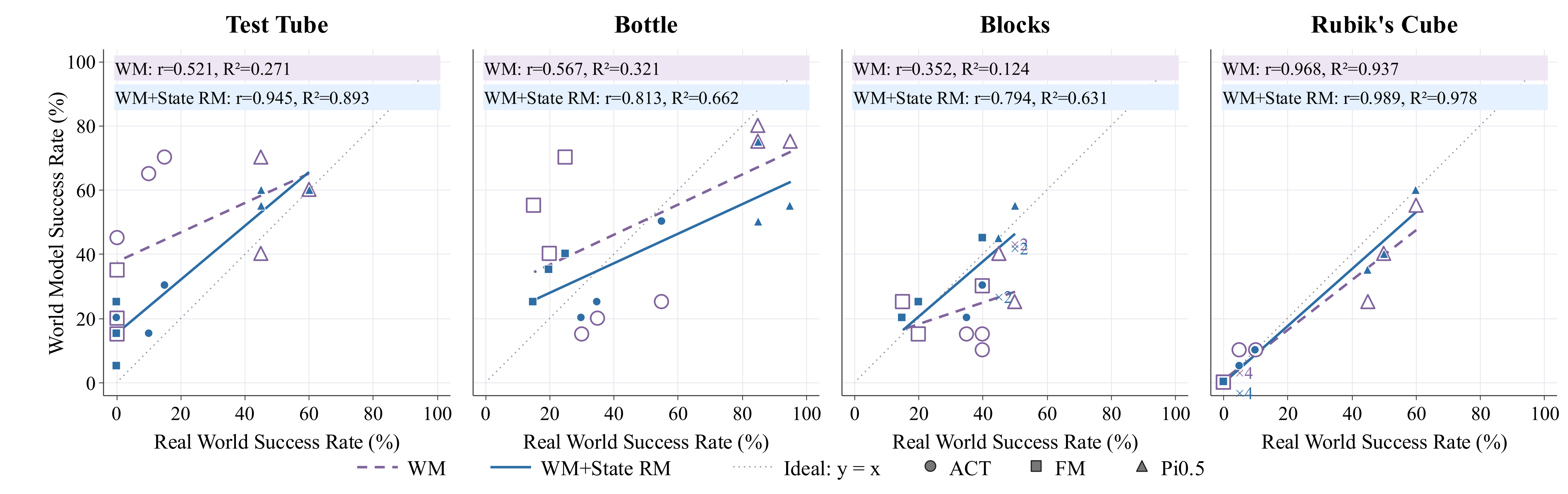
Each point compares world-model and real-world success rates for one evaluation batch. State supervision improves agreement across four tasks, increasing mean task-wise Pearson correlation from 0.602 to 0.885. The dotted diagonal indicates ideal agreement.
Policy Learning
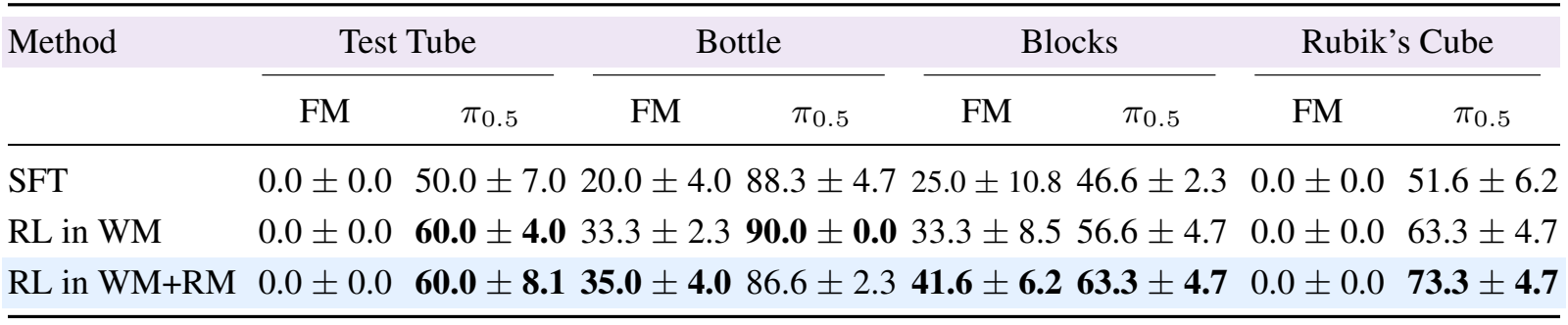
Real-world policy success rates (%) after supervised fine-tuning or reinforcement learning in the world model. Values are mean ± population standard deviation over three runs. Learning in the consistency-post-trained simulator improves average real-world performance, with gains varying by task.
Real-World Testing
Selected baseline and GRPO policy rollouts. Episodes are not paired and do not estimate success rates.
Flow Matching (FM)
Baseline failure 1Baseline failure 2After GRPO
Test tube
Failure · The tube drops beside the tray before rack placement.Failure · The tube is not successfully lifted and placed in the rack.Failure · Reaches the rack, but the tube is not seated and the rack is displaced.
Bottle
Failure · The bottle is released with the cap still attached.Failure · Repeated grasp-and-turn attempts do not separate the cap.Success · Unscrews the cap and leaves the bottle and cap separated.
Blocks
Failure · The green bag is knocked over during placement.Failure · The blocks are left on the table rather than inside their bags.Success · Separates the blocks and places both into the matching bags.
ACT
Rubik's Cube
Missed grasp.Face remains uncorrected.Dropped before placement.
π₀.₅
Baseline failure 1Baseline failure 2After GRPO
Test tube
Failure · The tube is not retained upright in the rack after release.Failure · The tube is left lying on the tabletop beside the rack.Success · Completes the handover and leaves the tube standing in the rack.
Bottle
Failure · Turning ends without separating the cap from the bottle.Failure · Releases the bottle before the cap has been removed.Success · Removes the cap and places it separately from the bottle.
Blocks
Failure · The green block misses its bag and remains on the table.Failure · Neither block reaches its bag after the separation attempt.Success · Separates and deposits both blocks into their matching bags.
Rubik's Cube
Failure · The face turn remains incomplete when the Rubik's Cube is set down.Failure · Releases the Rubik's Cube with a visibly offset layer.Success · Completes the corrective face turn and sets down the aligned Rubik's Cube.
Outcomes are visually assessed; failure descriptions refer to observed behavior.